
Chef Lupita
Aporreadillo Michoacano con Huevo
Michoacán's Tierra Caliente almuerzo, where salted beef is softened, pounded, fried in lard, folded with egg and chile perón salsa, then served beside morisqueta like a proper working table.
A cooking platform built around craft, culture, and the stories behind what we eat.
Created by
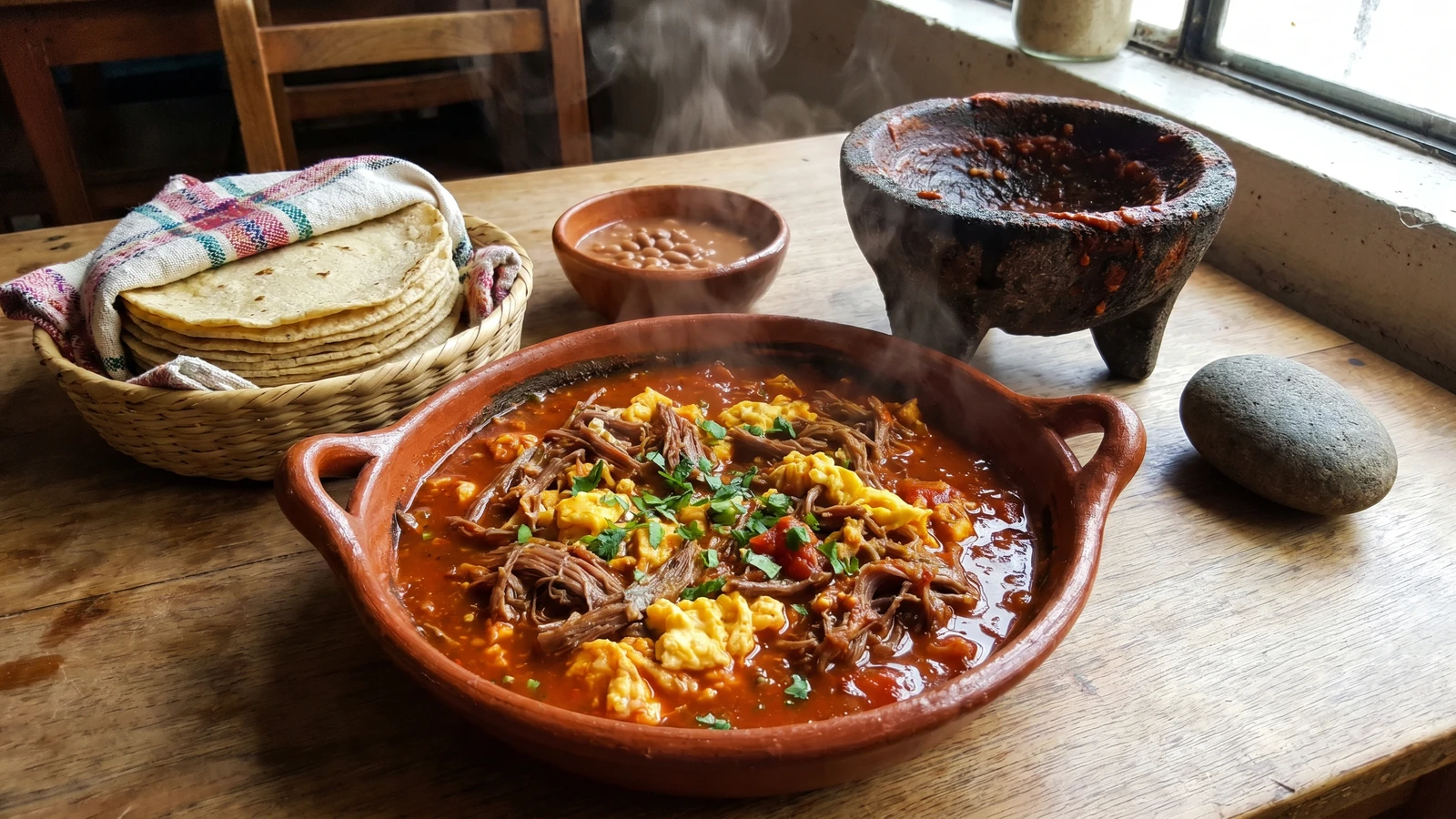
Guerrero's Costa Grande aporreado is salted cecina pounded soft, scrambled with egg, and finished in a red guajillo and chile de árbol salsa loud with garlic and cilantro.
Guerrero, Costa Grande first and then the hot inland road toward Tierra Caliente, is where this aporreado lives. This is not a little egg dish for a polite desayuno. This is almuerzo: the mid-morning plate that lets a person work until late afternoon without complaining.
The meat defines it. Older cooks talk about venison, pounded with a stone until the fibers surrendered. Today you use cecina de res oreada, salted and dried enough to keep, then beaten soft and shredded by hand. That pounding is why the dish has its name. If you skip it, you haven't made aporreado. You have made scrambled eggs with meat and called it a costume.
The salsa is red in this version: chile guajillo for body, chile de árbol for bite, jitomate tatemado, garlic, cumin, pimienta gorda, and fresh cilantro. I learned a version like this from a woman near Tecpan who cooked it in a blackened cazuela and served it with tortillas wrapped in a faded servilleta. She didn't measure the garlic. She looked at my hand and said, more. She was right.
My mother was from Jalisco, so this was not her daily pot, but her notebook taught me the same rule: preserve what feeds people. Salt the meat. Dry it. Pound it. Stretch it with egg and salsa. Saber cocinar es saber vivir.
Aporreadillo is documented in Guerrero's Costa Grande as a dish born from preserving beef before household refrigeration: the meat was salted, dried in the sun for several days, pounded with stone, shredded, and then cooked with egg and salsa. In the borderlands of Huetamo, Michoacán, and northern Guerrero, older versions are remembered with venison, but current practice relies on cecina or carne seca because hunting rules and cattle ranching changed the table. Red versions usually lean on guajillo, chile de árbol, garlic, and cilantro, while green versions use fresh green chiles, proving again that the dish belongs to a region, not to one fixed national recipe.
Quantity
1 pound
Quantity
5
stemmed and seeded
Quantity
3
stemmed
Quantity
5 ripe
Quantity
1/2 medium
cut into thick wedges
Quantity
1/4 medium
thinly sliced
Quantity
3
unpeeled
Quantity
1/2 teaspoon
Quantity
3
Quantity
1 teaspoon, plus more to taste
Quantity
1 1/2 cups, plus more as needed
Quantity
2 tablespoons
Quantity
8
lightly beaten
Quantity
1/2 cup
chopped, divided
Quantity
for serving
Quantity
for serving
Quantity
for serving
Quantity
for serving
crumbled
| Ingredient | Quantity |
|---|---|
| cecina de res oreada or carne seca salada | 1 pound |
| dried chile guajillostemmed and seeded | 5 |
| dried chile de árbolstemmed | 3 |
| Roma tomatoes (jitomate guaje) | 5 ripe |
| white onioncut into thick wedges | 1/2 medium |
| white onionthinly sliced | 1/4 medium |
| garlic clovesunpeeled | 3 |
| cumin seeds | 1/2 teaspoon |
| pimienta gorda berries | 3 |
| kosher salt | 1 teaspoon, plus more to taste |
| hot water | 1 1/2 cups, plus more as needed |
| manteca de cerdo | 2 tablespoons |
| large eggslightly beaten | 8 |
| fresh cilantro leaves and tender stemschopped, divided | 1/2 cup |
| warm corn tortillas (optional) | for serving |
| frijoles de la olla (optional) | for serving |
| cooked white rice or morisqueta (optional) | for serving |
| queso fresco de rancho (optional)crumbled | for serving |
Taste a tiny corner of the cecina. If it is aggressively salty, rinse it quickly under cold water and pat it completely dry. Do not soak it like laundry. Lay the cecina on a stone slab or heavy cutting board, cover it with a clean towel, and pound it with a smooth stone or meat mallet until the fibers loosen. Tear it into thin shreds. Aporreado means hit. That is not decoration, it is the technique.
Heat a dry comal over medium. Toast the guajillos one at a time, about 15 seconds per side, just until the skin darkens slightly and smells fruity. Toast the chile de árbol for only a few seconds. It burns fast and turns sharp in a bad way. Put the toasted chiles in a bowl and cover with the hot water for 12 minutes. Hot water softens the flesh. Boiling water punishes it.
On the same comal, roast the jitomates, onion wedges, and unpeeled garlic until the skins blister and blacken in spots, 8 to 10 minutes. Turn them as they soften. Peel the garlic. Toast the cumin seeds and pimienta gorda for 30 seconds, shaking the comal so they do not scorch. The salsa should taste roasted, not burned. There is a difference, and your nose knows it.
Drain the chiles, saving the soaking liquid. Blend the guajillo, chile de árbol, roasted jitomates, roasted onion, peeled garlic, toasted cumin, pimienta gorda, 1/4 cup cilantro, 1 teaspoon salt, and 3/4 cup chile soaking liquid until smooth. A molcajete gives you a rougher salsa and more authority. A blender works when you blend long enough. No me vengas con atajos that leave chile skins in the sauce.
Melt the manteca de cerdo in a wide cazuela de barro or heavy skillet over medium heat. Add the sliced onion and cook until it softens at the edges, about 3 minutes. Add the shredded cecina and fry, stirring often, until the meat darkens and the edges catch a little color, 4 to 6 minutes. La manteca es el sabor. Oil will cook it. Manteca will make it taste like almuerzo.
Lower the heat to medium-low. Pour in the beaten eggs slowly while stirring with a wooden spoon, so the egg forms small curds around the cecina instead of one dry sheet. Cook just until the eggs are barely set. They will finish in the salsa. If you overcook them now, the final guiso will be tough. The señora looking over your shoulder would tell you the same thing.
Pour the red salsa over the cecina and eggs. Rinse the blender with 1/2 cup water and add that to the cazuela. Stir gently, bring to a low simmer, and cook for 8 to 10 minutes, until the salsa thickens, the chile stains the eggs red-orange, and small dots of fat shine at the surface. Taste for salt only at the end. Cecina keeps giving salt as it cooks.
Turn off the heat and fold in the remaining 1/4 cup cilantro. Serve straight from the cazuela with warm corn tortillas, frijoles de la olla, white rice or morisqueta, and queso fresco de rancho on the side. Corn tortillas, not flour. This is Guerrero, not the northern border. Cada estado, su propia cocina.
1 serving (about 505g)
Culinary guides, cultural storytelling, and the editorial depth that makes cooking meaningful.
Discover Culinary ExplorerChef Lupita
Michoacán's Tierra Caliente almuerzo, where salted beef is softened, pounded, fried in lard, folded with egg and chile perón salsa, then served beside morisqueta like a proper working table.

Chef Lupita
Los Altos de Chiapas turns two-night fermented white corn into a tart-sweet atole, cooked with canela and piloncillo, then poured hot into jícaras for desayuno.

Chef Lupita
Oaxaca's Mixteca region ferments nixtamalized masa for days until it turns tart and alive, then simmers it with piloncillo and canela into a thick, warm atole served at first light in clay.

Chef Lupita
Tulyehualco's morning atole from the chinampas of Xochimilco, built on amaranto popped on the comal, ground smooth, and simmered with whole milk, piloncillo, and Mexican canela. The huauhtli of pre-Hispanic CDMX in a clay jarro.