
Chef Freja
Æblegelé
Tart autumn apples, slow-boiled and strained clear overnight, then cooked with sugar to a trembling pale amber jelly that belongs on the cheese board, on morning toast, and in the kitchen of anyone who respects the season.
A cooking platform built around craft, culture, and the stories behind what we eat.
Created by Chef Freja
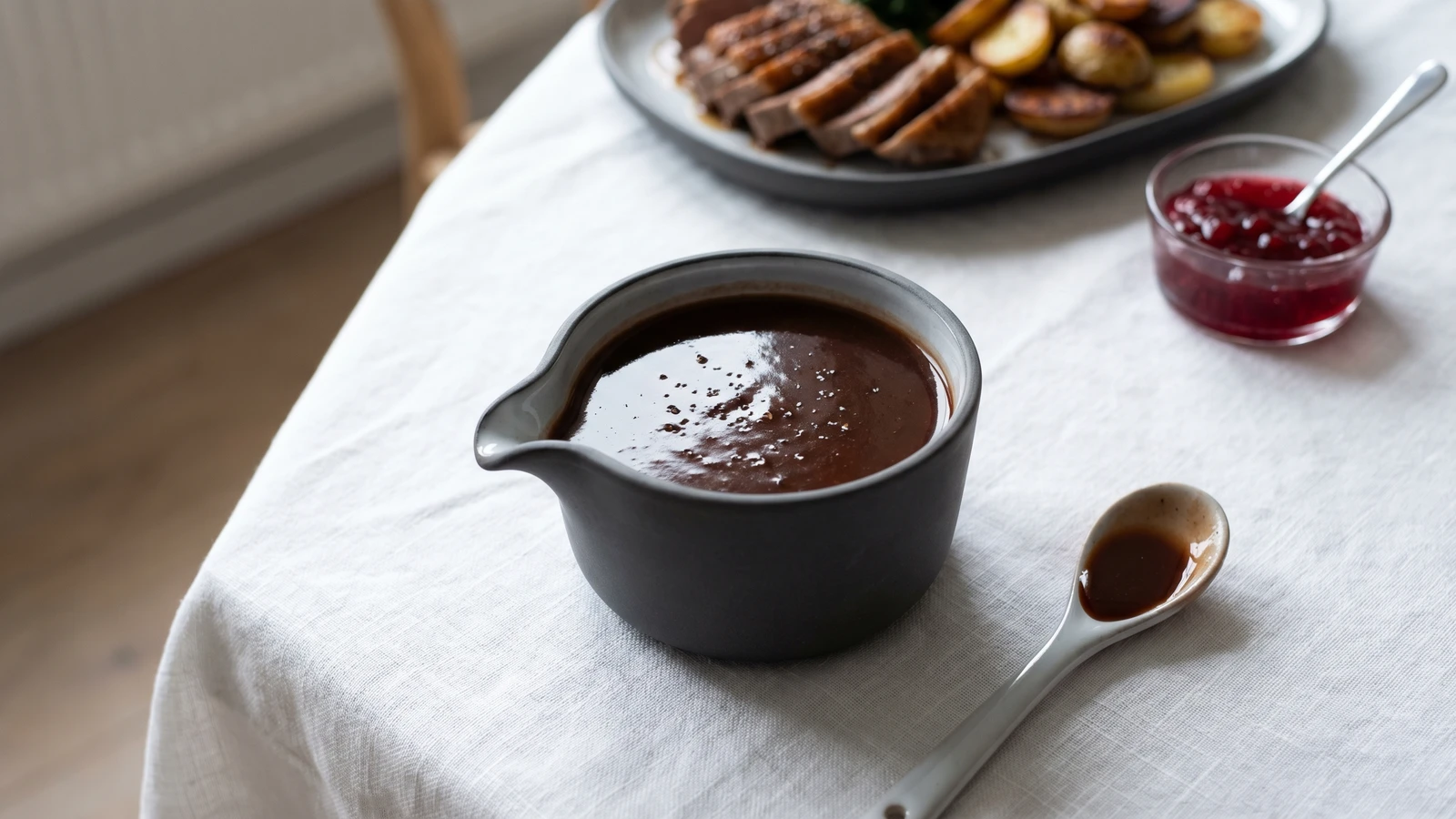
The pan sauce that holds the Danish Christmas plate together. Duck drippings, good stock, cream, and a spoonful of red currant jelly for the tart brightness that makes juleaften taste like itself.
December in Denmark has a rhythm. The calendar candle burns down one number at a time, the julefrokost invitations pile up, and by the twenty-fourth the whole country turns inward. Juleaften. The tree is lit with real candles, the family sits down, and at the center of the table is andesteg, the roasted duck. But ask any Dane what holds the plate together and they'll tell you: it's the sovs.
Andesovs is a pan sauce in the truest sense. It begins in the roasting pan itself, in the dark, caramelized fond the duck leaves behind after hours in the oven. You build it the way all good gravies are built: fat, flour, stock, patience. Then you take it somewhere distinctly Danish with a spoonful of ribs, red currant jelly, whose bright tartness cuts through the richness of duck fat and cream and brings everything into balance. It's the thread that connects the duck to the brunede kartofler and the rødkål. Without it, the plate is just ingredients. With it, it's juleaften.
Pay attention to two moments. First, the fond. Those dark bits stuck to the bottom of the roasting pan are not burned; they are the concentrated soul of your duck, and you want every last trace dissolved into the stock. Second, the ribs. Add it at the end, a little at a time, tasting as you go. The balance between savory depth and that clean, tart sweetness is what makes this sauce Danish. You'll know when it's right.
The Danish Christmas duck, andesteg, became the standard juleaften centerpiece during the 19th century, gradually replacing roast goose in most households, though goose remains the tradition in parts of southern Jutland near the German border. The accompanying sauce evolved from simple pan gravy thickened with flour into the cream-enriched, red currant-finished version most Danish families recognize today. Ribs, the Danish red currant jelly, is the defining ingredient: its tartness balances the richness of duck fat in a way that sugar or vinegar alone cannot, and its presence on the Christmas table is so expected that running out mid-meal is considered a minor household disaster.
Quantity
from 1 duck roasting pan
Quantity
2 tablespoons
reserved from the roasting pan
Quantity
2 tablespoons
Quantity
500ml
Quantity
150ml
Quantity
2-3 tablespoons
Quantity
to taste
Quantity
freshly ground, to taste
Quantity
1 tablespoon
| Ingredient | Quantity |
|---|---|
| drippings and fond from roasted duck | from 1 duck roasting pan |
| duck fatreserved from the roasting pan | 2 tablespoons |
| plain flour | 2 tablespoons |
| duck or chicken stock | 500ml |
| heavy cream (piskefløde) | 150ml |
| red currant jelly (ribs) | 2-3 tablespoons |
| fine sea salt | to taste |
| black pepper | freshly ground, to taste |
| port (optional) | 1 tablespoon |
Lift the duck from the roasting pan and set it on a board to rest. Don't clean the pan. Everything you need is in there. Carefully pour off the liquid fat into a heatproof bowl, leaving behind the dark, sticky fond and about two tablespoons of fat clinging to the bottom. That bowl of duck fat is gold: save it for brunede kartofler or for roasting potatoes in January. The fond that stays in the pan is the foundation of your sauce.
Set the roasting pan across two burners over medium heat. Sprinkle the flour into the fat and fond and stir with a wooden spoon, scraping as you go. You're doing two things at once: cooking the raw taste out of the flour and loosening the caramelized bits from the bottom of the pan. Give it about two minutes. The mixture will darken slightly and smell nutty. That's the signal to keep moving.
Pour in the stock in a slow, steady stream, whisking constantly. The sauce will seize and look lumpy at first. Keep whisking. It smooths out as the stock incorporates. Scrape every last trace of fond from the corners of the pan. Those dark bits are hours of duck flavor concentrated into caramel, and you want all of it in your sauce. Bring everything to a gentle simmer, still whisking, until the liquid thickens enough to coat the whisk.
Let the sauce simmer for ten minutes, stirring occasionally. It will thicken gradually and the surface will start to look glossy. Strain it through a fine sieve into a clean saucepan, pressing on any solids with the back of a spoon. You want the sauce perfectly smooth. Anything gritty or lumpy belongs in the sieve, not on the plate. Discard what the sieve catches.
Stir the cream into the strained sauce and bring it back to a gentle simmer. Now add the red currant jelly, one tablespoon at a time. Stir until each spoonful dissolves completely, then taste. What you're looking for is a subtle tartness that lifts the richness without sweetening the sauce. Most ducks need two tablespoons. Some need three. Trust your palate. When the sauce tastes balanced, bright but still deeply savory, that's when it's right.
Season with salt and pepper. The sauce should coat the back of a spoon and fall in a lazy ribbon when you lift it. If it's too thick, thin it with a splash of stock. If it's too thin, let it simmer uncovered for a few minutes longer. Pour into a warm sauce boat and bring it to the table alongside the duck, the brunede kartofler, and the rødkål. This is the thread that ties the whole plate together. Tak for mad.
1 serving (about 100g)
Culinary guides, cultural storytelling, and the editorial depth that makes cooking meaningful.
Discover Culinary ExplorerChef Freja
Tart autumn apples, slow-boiled and strained clear overnight, then cooked with sugar to a trembling pale amber jelly that belongs on the cheese board, on morning toast, and in the kitchen of anyone who respects the season.

Chef Freja
Autumn apples simmered slowly with vanilla until they collapse into a rough, golden sauce. The condiment that waits on the shelf for flaeskesteg, for roast duck, for the meals that carry you through the Danish winter.

Chef Freja
September plums slow-cooked with onion, ginger, vinegar, and warm spice into a dark, glossy chutney that belongs beside aged cheese on a cold evening. The joy of waiting, sealed in a jar.

Chef Freja
Ripe September plums from Fyn orchards, cooked slowly with sugar and cinnamon until the color deepens to garnet and the kitchen smells like the place where autumn meets winter. Give it a week on the shelf. It only gets better.