
Chef Klaus
Ähzezupp (Kölsche Erbsensuppe)
The Cologne pea pot earns its depth from soaked peas and cured pork bone, simmered slowly until the soup thickens itself and the meat falls clean from the knuckle.
A cooking platform built around craft, culture, and the stories behind what we eat.
Created by
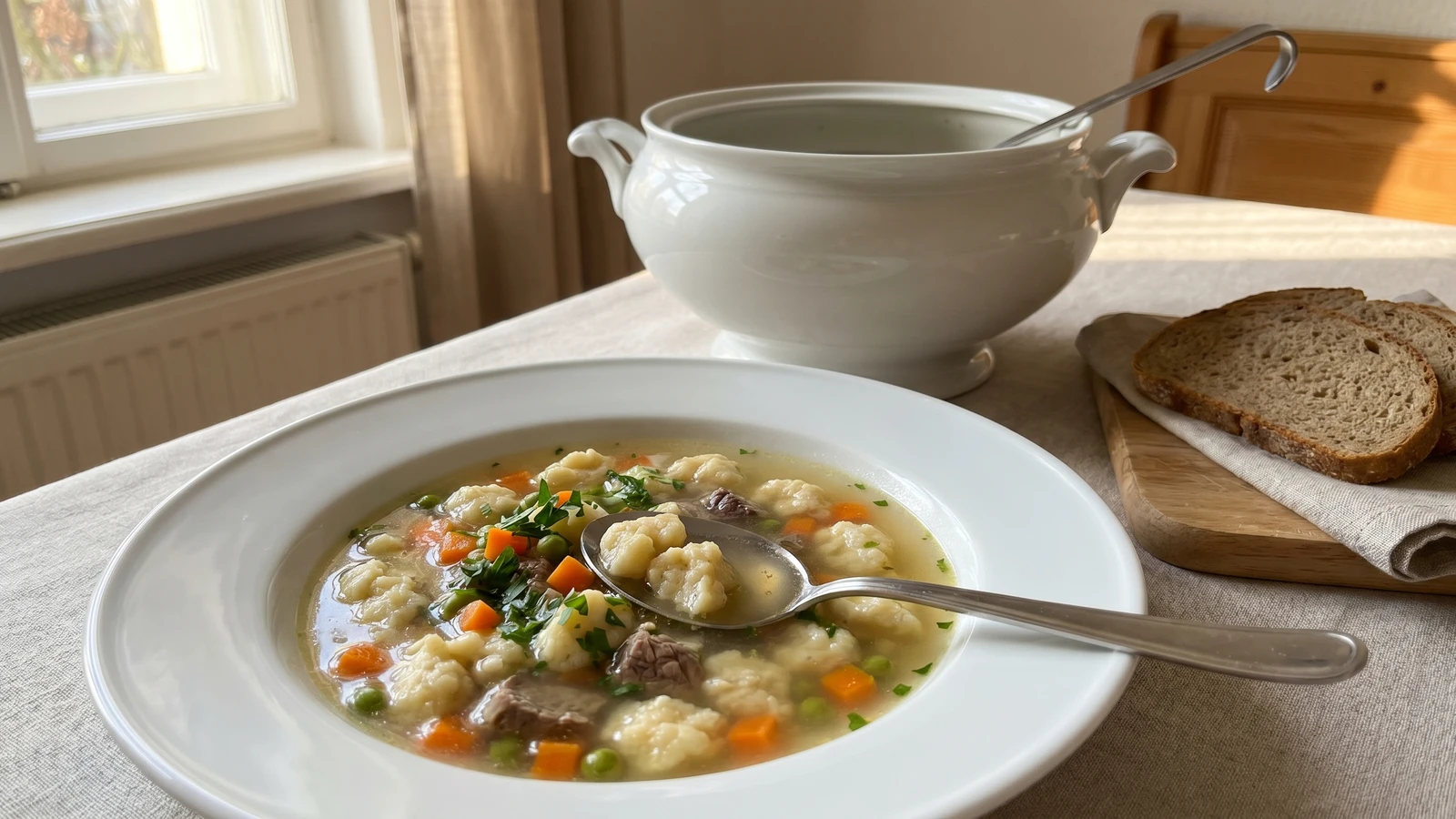
The Altmark wedding broth is a clear soup with no tricks: bones for depth, patient skimming for clarity, and small semolina dumplings that make it festive.
Altmärkische Hochzeitssuppe belongs to the old wedding table of the Altmark, that flat northern stretch of Saxony-Anhalt where a clear broth could be the proudest course in the room. It is celebration food made from thrift: beef bones, soup meat, carrots, leeks, peas, and little Grießklößchen, semolina dumplings. The poor table knew exactly where the value was. Weggeworfen wird nichts.
Every region puts its hand on wedding soup differently. In Westphalia and Lower Saxony you often see chicken broth, Eierstich, egg custard, asparagus, or tiny meatballs. In the Altmark I keep the broth beefy and clear, with the dumplings small enough for a spoon and the vegetables cut neat. Im Norden anders, im Süden anders. German food has no single wedding soup.
The technique that decides the dish is the simmer. Never boil the stock hard. A rolling boil breaks fat and protein into the liquid, and then your festive broth turns cloudy before you've even strained it. Bring it up slowly, skim it clean, then runter mit der Temperatur, down with the temperature, until the bones and meat give themselves up quietly.
The dumplings are simple, but they need resting. Hot milk and butter swell the semolina first, so the grains drink before the egg goes in; skip the rest and the dumplings cook up gritty or fall apart. Erst verstehen, dann kochen.
The Altmark, first recorded as the Nordmark in the 10th century and later tied to Brandenburg and Prussian rural cooking, kept wedding meals practical because meat was expensive and broth stretched value from bones, marrow, and soup meat. German Hochzeitssuppe became a regional family of clear festive soups in the 18th and 19th centuries, with northern versions often built on chicken and Eierstich while Altmark recipes leaned on beef broth and small dumplings. The surprising part is the economy: what looks plain was once the celebration course, because a clear stock meant enough bones, enough time, and a cook who knew how to keep it clean.
Quantity
1.2kg
marrow bones and joint bones if possible
Quantity
500g
in one piece
Quantity
2
one roughly chopped for stock, one finely diced for serving
Quantity
1
washed and roughly chopped
Quantity
1 small wedge
roughly chopped
Quantity
1
halved with skin on
Quantity
2
Quantity
8
Quantity
2
lightly crushed
Quantity
2 litres
Quantity
to taste
Quantity
80g
Quantity
250ml
Quantity
30g
Quantity
1
Quantity
to taste
Quantity
100g
fresh or frozen
Quantity
2 tablespoons
chopped
| Ingredient | Quantity |
|---|---|
| beef soup bonesmarrow bones and joint bones if possible | 1.2kg |
| beef shin or brisketin one piece | 500g |
| carrotsone roughly chopped for stock, one finely diced for serving | 2 |
| leekwashed and roughly chopped | 1 |
| celeriacroughly chopped | 1 small wedge |
| onionhalved with skin on | 1 |
| bay leaves | 2 |
| black peppercorns | 8 |
| juniper berrieslightly crushed | 2 |
| cold water | 2 litres |
| salt | to taste |
| semolina | 80g |
| whole milk | 250ml |
| butter | 30g |
| egg | 1 |
| freshly grated nutmeg | to taste |
| peasfresh or frozen | 100g |
| flat-leaf parsleychopped | 2 tablespoons |
Put the bones, beef, roughly chopped carrot, leek, celeriac, onion, bay, peppercorns, juniper, and cold water in a large pot. Start with cold water because the slow climb pulls flavour and soluble protein out gently; drop bones into boiling water and the outside tightens before the broth has taken what it needs.
Bring the pot slowly just to a tremble, skimming the grey foam as it rises. Do not let it boil hard. A hard boil smashes fat and scum into the liquid, and then no sieve in the world gives you a wedding-clear broth. Once clean, keep it barely moving for 2 1/2 to 3 hours, until the beef is tender.
While the stock simmers, bring the milk, butter, a good pinch of salt, and nutmeg to a gentle boil. Stir in the semolina and cook, stirring, until it pulls from the pan in a thick mass. Let it cool for 10 minutes before beating in the egg, because egg in a boiling paste cooks into strings instead of binding the dumpling.
With wet teaspoons, shape small dumplings no bigger than a walnut. Poach one tester in lightly salted water that trembles but does not boil; if it holds, cook the rest for 8 to 10 minutes. Boiling water batters them apart, and large dumplings turn heavy in the middle before the outside is set.
Lift out the beef and keep it covered. Strain the broth through a fine sieve lined with a clean cloth, then let the fat settle and skim off what floats. Do not press the vegetables through the sieve; pressing clouds the broth, and this soup earns its place by staying clear.
Dice the cooked beef neatly and return it to the clear broth with the finely diced carrot. Simmer until the carrot is just tender, then add the peas for the last 2 minutes so they stay green instead of army-grey. Taste now for salt. Würzen, Fett, Salz zum Schluss, because only the finished broth tells you what it needs.
Divide the semolina dumplings among warm bowls and ladle the clear broth, beef, carrots, and peas over them. Finish with chopped parsley. The bowl should look pale gold, green, orange, and clean, not like a pot that lost its temper. Schön ist, was schmeckt.
1 serving (about 410g)
Culinary guides, cultural storytelling, and the editorial depth that makes cooking meaningful.
Discover Culinary ExplorerChef Klaus
The Cologne pea pot earns its depth from soaked peas and cured pork bone, simmered slowly until the soup thickens itself and the meat falls clean from the knuckle.

Chef Klaus
The Allgäu's Alpine cheese soup works only if the Bergkäse melts gently off the heat, where it turns smooth instead of stringy.

Chef Klaus
A firm egg dough, grated into tiny crumbs and cooked in clear broth: Allgäu kitchen thrift, warm in the bowl, and finished only when the Riebele keep their bite.

Chef Klaus
A bowl of Baden carnival: dried beans, smoked bacon, potato, and the patience to cook them soft before the Narren come in hungry.