
Chef Lupita
Agua de Alfalfa
Ciudad de México's highland market agua fresca, fresh alfalfa blended with pineapple and lime until bright green, strained clean, and poured cold from the vitrolero.
A cooking platform built around craft, culture, and the stories behind what we eat.
Created by
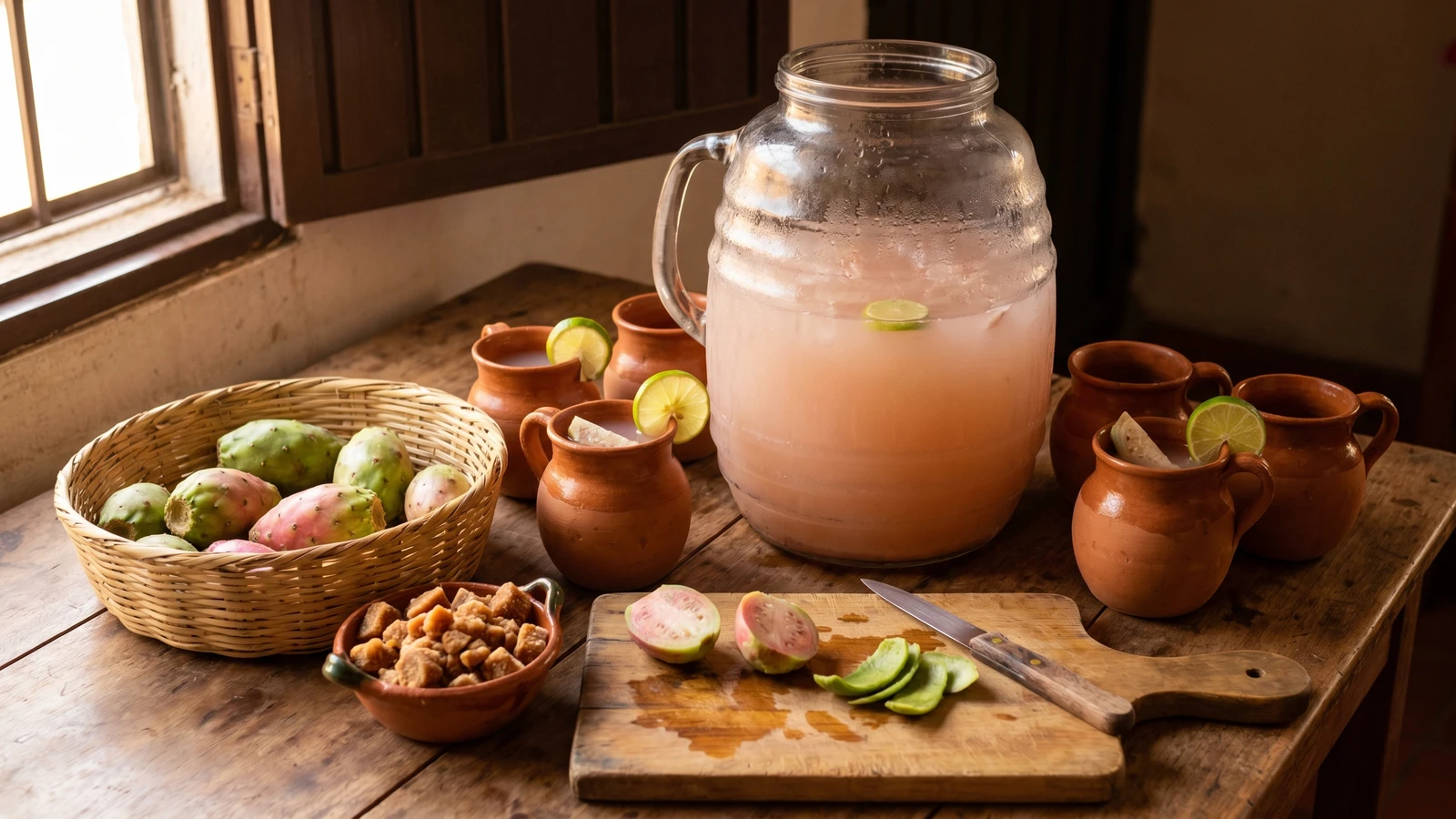
Queretaro's Bajio agua fresca, made from acidic pink xoconostle peeled by hand, blended with water and piloncillo, and served cold when the altiplano heat gets serious.
Queretaro, in the Bajio, is where this agua belongs. The xoconostle grows on nopal in dry country, the kind of semi-arid land that teaches cooks not to waste anything. In the mercados of Queretaro and San Juan del Rio, you see the fruits piled in baskets, pale green outside, pink and sharp inside.
This is not lemonade with cactus fruit thrown in. Xoconostle has its own acidity, more stern than sweet tuna, with a clean bite that makes sense in the heat of the altiplano. You peel it, seed it, blend it with water, and sweeten it with piloncillo just enough to let the fruit speak. Too much sugar kills the point. No me vengas con atajos.
I learned this version from a woman near the Mercado La Cruz who sold nopales, tunas, and xoconostles from the same stall. She told me to keep the drink tart because that is what wakes the body when the afternoon is dry and dusty. She was right. Cada estado, su propia cocina, and the Bajio knows its cactus fruit.
Xoconostle comes from Nahuatl, from 'xococ' meaning sour and 'nochtli' meaning prickly pear fruit, and it has been used in central Mexican cooking since pre-Columbian times. In the Bajio and the neighboring central altiplano, xoconostle appears in salsas, moles de olla, preserves, and aguas frescas because the cactus thrives where many sweeter fruits struggle. Its use in drinks reflects a practical regional habit: acidic fruit, water, and cane sweetener turned into refreshment for hot market days before bottled sodas took over the table.
Quantity
10
preferably pink-fleshed, peeled, halved, and seeded
Quantity
8 cups
divided
Quantity
4 ounces
chopped
Quantity
1/2 cup
for dissolving piloncillo
Quantity
2 tablespoons, plus more to taste
Quantity
1/4 teaspoon
Quantity
for serving
| Ingredient | Quantity |
|---|---|
| ripe xoconostlespreferably pink-fleshed, peeled, halved, and seeded | 10 |
| cold waterdivided | 8 cups |
| piloncillochopped | 4 ounces |
| hot waterfor dissolving piloncillo | 1/2 cup |
| fresh lime juice | 2 tablespoons, plus more to taste |
| fine sea salt | 1/4 teaspoon |
| ice (optional) | for serving |
Rinse the xoconostles under cool water and dry them. Trim off both ends, make a shallow lengthwise cut through the thick skin, and pull the peel away with your fingers or a small knife. The skin is tougher than tuna roja, and the acidity sits in the flesh, not in the peel. Work over a bowl because the pink juice stains in the honest way cactus fruit stains.
Cut each xoconostle in half and scoop out the seed packet with a spoon. Do not blend the seeds. They are hard and they make the drink gritty. The señoras in the Queretaro markets do this quickly because they have peeled thousands of them. You will be slower. Fine. Do it cleanly.
Put the chopped piloncillo in a small bowl with 1/2 cup hot water. Stir until dissolved, pressing any stubborn pieces against the bowl. Piloncillo gives the agua a cane-sugar depth that white sugar cannot give. If you use plain sugar, the drink will be sweet, but flatter. A substitution is a compromise, not an upgrade.
Add the peeled xoconostle flesh to a blender with 3 cups of the cold water, the dissolved piloncillo, lime juice, and salt. Blend on high until the fruit breaks down completely and the liquid turns a cloudy pink. The salt is not there to make it salty. It sharpens the fruit and keeps the drink from tasting thin.
Pour the blended mixture through a fine-mesh strainer into a large clay jarro, glass pitcher, or vitrolero. Press gently with a spoon, but do not force the pulp so hard that fibers pass through. Agua fresca should have body, yes, but not sludge. La cocina no es decoracion, es trabajo.
Stir in the remaining 5 cups cold water. Taste. Xoconostle should be tart first, sweet second. Add a little more lime if the fruit is dull, or a little more dissolved piloncillo if the fruit is aggressively sour. Do not drown it in sugar. If you wanted candy water, you would not be using xoconostle.
Serve over ice in clay jarritos or thick glasses. Stir the pitcher before each pour because natural fruit settles. This is a quick drink, but it is not careless. Recetas probadas y garantizadas.
1 serving (about 300g)
Culinary guides, cultural storytelling, and the editorial depth that makes cooking meaningful.
Discover Culinary ExplorerChef Lupita
Ciudad de México's highland market agua fresca, fresh alfalfa blended with pineapple and lime until bright green, strained clean, and poured cold from the vitrolero.

Chef Lupita
Aguascalientes' Lenten agua fresca, jewel-red from cooked beet and full of apple, banana, orange, lettuce, and ground peanuts, served cold when Holy Week meets the Feria de San Marcos.

Chef Lupita
Sonora and Sinaloa's creamy malted barley water, built on toasted cebada perla, Mexican canela, vanilla from Papantla, and evaporated milk. Pink-beige, rich, and served cold over heavy ice in a heavy glass tumbler. Liquid cookie comfort the northwest way.

Chef Lupita
Yucatán's everyday tonic of boiled chaya leaves blended with lima agria, sugar, and ice. The bright green jarra that sits on every Peninsula table from Mérida to Valladolid.