
Chef Freja
Æblegelé
Tart autumn apples, slow-boiled and strained clear overnight, then cooked with sugar to a trembling pale amber jelly that belongs on the cheese board, on morning toast, and in the kitchen of anyone who respects the season.
A cooking platform built around craft, culture, and the stories behind what we eat.
Created by Chef Freja
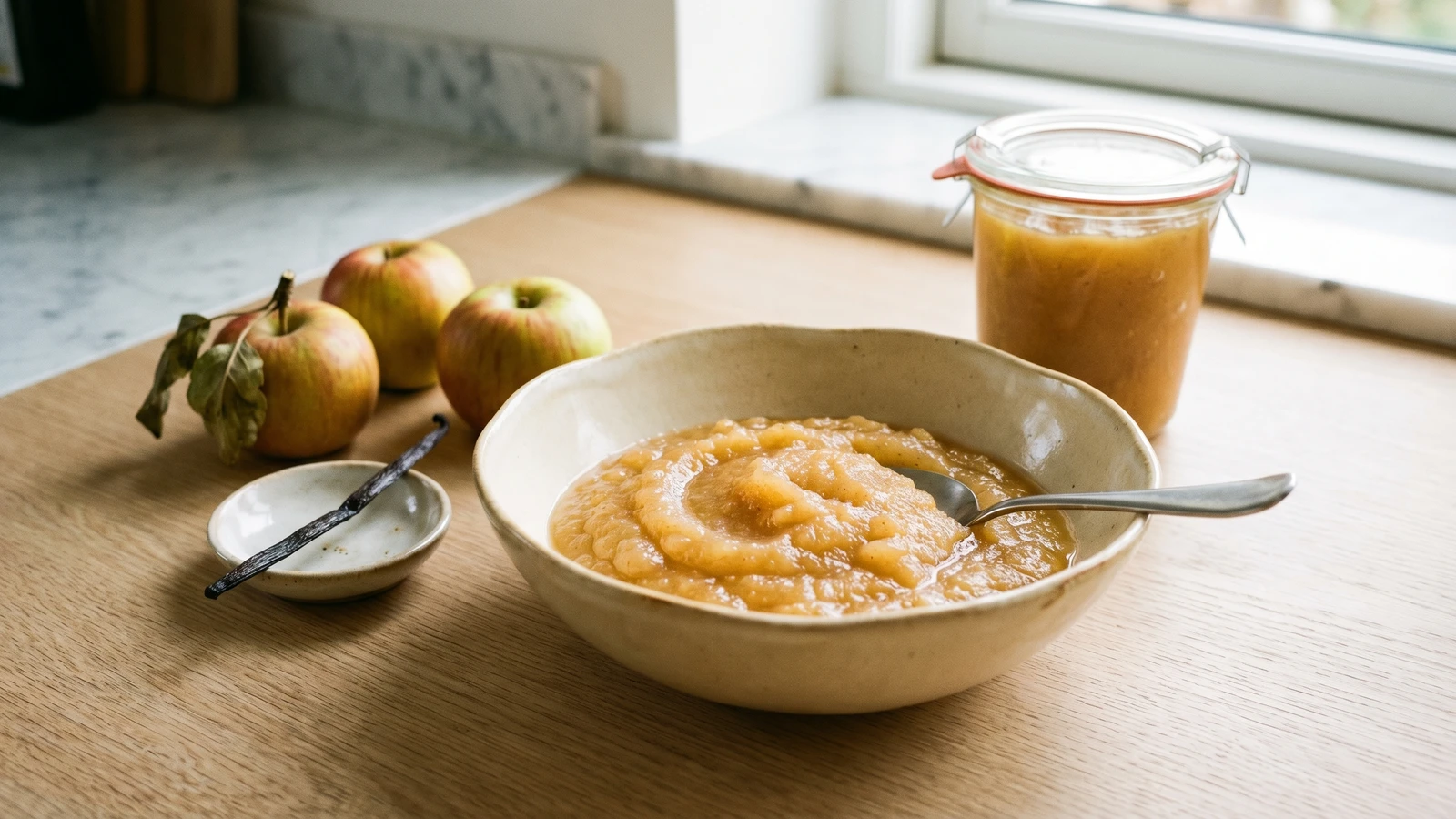
Autumn apples simmered slowly with vanilla until they collapse into a rough, golden sauce. The condiment that waits on the shelf for flaeskesteg, for roast duck, for the meals that carry you through the Danish winter.
The apple trees in Denmark give everything at once. By late September the branches are heavy with it, and you pick knowing that the window is short. Some of those apples go into cakes, some into the cellar, but the ones that are bruised or too tart for eating go into the pot. This is when aeblemos happens.
Aeblemos is the Danish kitchen's quiet workhorse. It sits in jars on the shelf from October onward, waiting for the meals it was made for: beside flaeskesteg on Christmas Eve, alongside aebleskiver on a dark afternoon, spooned onto a plate next to crisp pork belly any night the winter asks for something warm and complete. It is not a recipe that calls attention to itself. It does what a good condiment does: it makes everything around it better.
The method is as simple as cooking gets. You simmer tart apples with a little water and a vanilla pod until the fruit falls apart, sweeten it carefully, and mash it by hand. That's it. The only thing I want you to watch is the sugar. Start with less than you think you need and taste as you go. The apples should lead. If you can taste the sugar more than the fruit, pull back. You'll know when it's right, because the sauce will taste like the season itself, bright and warm and honest.
Aeblemos has been a staple of the Danish autumn kitchen since at least the 1800s, when apple orchards on Fyn and the southern islands produced more fruit each year than families could eat fresh. Preserving the surplus as mos became a practical necessity that evolved into tradition. Its inseparable pairing with flaeskesteg, the crisp-skinned roast pork served on Christmas Eve in most Danish homes, dates from the same period, and the combination of tart fruit and rich pork fat follows a logic older than any written recipe: acidity cuts richness, and the Danes understood this long before anyone called it a principle.
Quantity
1.5kg
peeled, cored, roughly chopped
Quantity
150ml
Quantity
80-120g, to taste
Quantity
1
split lengthways
Quantity
half a lemon
| Ingredient | Quantity |
|---|---|
| tart applespeeled, cored, roughly chopped | 1.5kg |
| water | 150ml |
| granulated sugar | 80-120g, to taste |
| vanilla podsplit lengthways | 1 |
| lemon juice | half a lemon |
Peel, quarter, and core the apples, then cut them into rough chunks about 3cm across. They don't need to be even. Uneven pieces collapse at different rates, and that's what gives aeblemos its texture: some pieces dissolve into smoothness while others hold just enough shape to remind you it was fruit. Drop the pieces into a bowl of water with a squeeze of lemon as you go. The acid keeps them from browning, but more importantly, it stays in the finished sauce and balances the sweetness.
Drain the apple pieces and tip them into a heavy-bottomed pot. Add the water and the split vanilla pod. The water is just enough to stop the apples from catching on the bottom before they release their own juice. Set it over a medium-low heat and cover with a lid. Let the apples simmer gently for fifteen to twenty minutes, stirring every five minutes or so. You'll hear them settle and soften. The kitchen will start to smell like October.
When the apples are completely soft and falling apart, remove the vanilla pod and scrape the seeds from inside with the back of a knife. Stir the seeds back into the pot. Now mash the apples with a potato masher or a fork. Aeblemos is not a puree. You want it rough, with body. Some smooth, some textured. If you blend it, you lose the character that makes it Danish and end up with baby food.
Add the sugar now, starting with 80g. Stir it through the warm fruit and taste. The sweetness should lift the apple flavor, not mask it. If you taste sugar before you taste apple, you've gone too far. How much you need depends entirely on the fruit. A sharp Boskoop in early October needs more than a ripe Ingrid Marie in November. Only by tasting do you really understand it. Add the rest of the lemon juice, stir, and taste once more.
If you're serving the aeblemos within the week, let it cool and transfer it to a clean jar. It thickens as it cools, and it should have the consistency of a soft, spoonable sauce, looser than jam, thicker than a compote. If you're putting it up for winter, ladle the hot aeblemos into sterilized jars, seal immediately, and turn them upside down for five minutes. The heat seals the lid. Stored in a cool, dark place, it keeps for months. This is how Danish kitchens stock the shelf for flaeskesteg through December and beyond.
1 serving (about 125g)
Culinary guides, cultural storytelling, and the editorial depth that makes cooking meaningful.
Discover Culinary ExplorerChef Freja
Tart autumn apples, slow-boiled and strained clear overnight, then cooked with sugar to a trembling pale amber jelly that belongs on the cheese board, on morning toast, and in the kitchen of anyone who respects the season.

Chef Freja
The pan sauce that holds the Danish Christmas plate together. Duck drippings, good stock, cream, and a spoonful of red currant jelly for the tart brightness that makes juleaften taste like itself.

Chef Freja
September plums slow-cooked with onion, ginger, vinegar, and warm spice into a dark, glossy chutney that belongs beside aged cheese on a cold evening. The joy of waiting, sealed in a jar.

Chef Freja
Ripe September plums from Fyn orchards, cooked slowly with sugar and cinnamon until the color deepens to garnet and the kitchen smells like the place where autumn meets winter. Give it a week on the shelf. It only gets better.